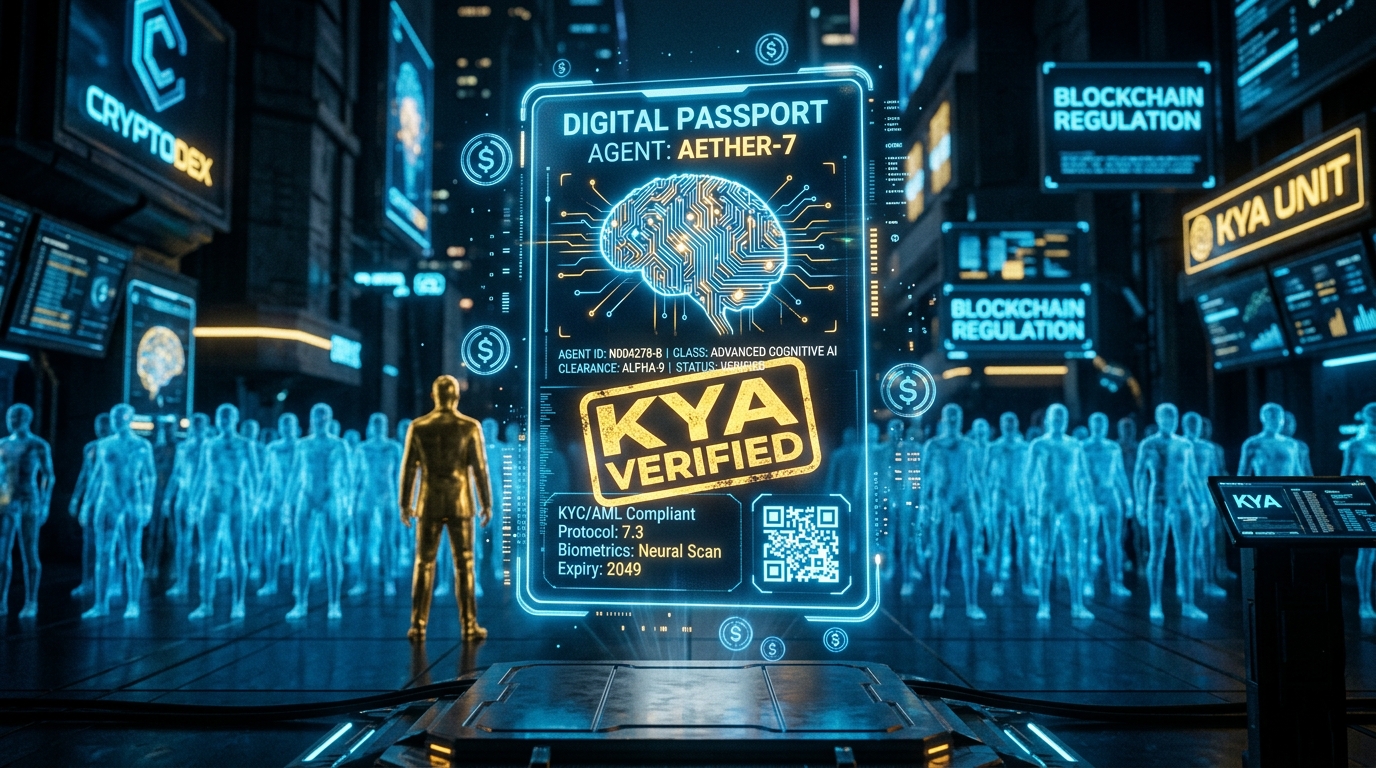
Non-Human Identities Outnumber Humans 96-to-1: The Rise of the AI Agent
Intelligence Bureau
As of March 14, 2026, we have officially entered the "Agentic Era" of decentralized finance. The traditional blockchain user—a human signing transactions via a browser extension—is becoming a relic. In their place, a new class of "non-human identities" has emerged, outnumbering human employees in the financial services sector by a staggering 96-to-1. These autonomous AI agents are not merely bots; they are persistent digital entities capable of planning, negotiating, and executing complex multi-step financial strategies.
This shift has birthed the most critical regulatory primitive of 2026: Know Your Agent (KYA). Spearheaded by industry leaders like Circle co-founder Sean Neville, KYA is moving from a theoretical concept to a mandatory compliance layer. The bottleneck for the crypto economy is no longer transaction speed—it is identity. Without cryptographically signed credentials that link an agent to its human principal and liability constraints, the "Internet of Agents" risks being blocked by traditional firewalls.
The economic scale of this revolution is already staggering. Fresh data from Circle reveals that over 400,000 AI agents now possess sovereign purchasing power, having completed 140 million autonomous payments totaling $43 million in the last nine months alone. With 98.6% of these settlements occurring in USDC, the stablecoin has quietly become the "native currency" of the machine-to-machine economy.
🌍 GLOBAL MARKET IMPACT
The rise of the agent economy is reshaping global capital flows. In Asia, particularly in Pakistan, "Sovereign AI" partnerships are hosting national data on-chain via the Internet Computer (ICP), allowing government-vetted agents to handle administrative tasks. In the US, Coinbase’s "Agentic Wallets" and Circle’s x402 protocol have commoditized machine payments, allowing AI systems to pay for their own API access and compute without human intervention.
Institutional sentiment is shifting from skepticism to "infrastructure-first" investment. The market is now pricing in the end of the "four-year cycle" theory, as AI-driven demand creates a 24/7/365 bid that is decoupled from human emotional trading. This "invisible revolution" is providing a floor for the market, even as geopolitical tensions in the Middle East cause temporary retail retreats.
🧠 ANALYST INSIGHT
"The web is moving from a 'Click Economy' to an 'Intent Economy,'" says one lead researcher at a16z. "In 2025, we had bots that could follow instructions. In 2026, we have agents that can conjecture relationships between ideas. The next step is 'agent-wrapping-agent' architectures, where specialized models audit each other's on-chain execution. This creates a techno-economic model where value flows automatically to the entity—human or machine—that contributes the most intelligence to a task."
⚠️ RISK FACTORS
The Invisible Tax: AI agents often extract data from ad-supported sites without contributing to the revenue streams that fund them, threatening the sustainability of the open web.
Identity Orphaning: If an AI agent commits a financial crime and its KYA link to a human principal is broken or never existed, the legal liability remains a "gray zone" that could trigger aggressive regulatory crackdowns.
Model Hallucination in Execution: While GPT-5.4 (supported by OpenClaw) is more reliable, "agentic drift" in complex DeFi strategies can still lead to catastrophic liquidation events if guardrails aren't strictly programmed.
🔮 NEXT 24-HOUR OUTLOOK
For the next 24 hours, monitor the VIRTUAL and NEAR pairs.
VIRTUAL: Trading at $0.735, the token is facing minor bearish divergence on the 4H chart. If it breaks below $0.70, expect a retest of the $0.67 support.
NEAR: Watch for a breakout above $8.50 as the "Confidential Intents" narrative gains steam. A successful close above this level could target $10.00 by week's end.
📈 KEY TAKEAWAYS
KYA is Mandatory: Compliance is shifting from "Know Your Customer" to "Know Your Agent" to manage the 96:1 machine-to-human identity ratio.
Machine-to-Machine Payments: USDC has solidified its role as the dollar of the AI economy, with $43M in autonomous payments settled.
Intent-Based Trading: The manual signing of transactions is being replaced by natural language "intents" (e.g., "maximize my yield on Base").
Sovereign AI: Countries like Pakistan are leading the charge in hosting national AI infrastructure on decentralized protocols.
Advertisement
728×90 Leaderboard