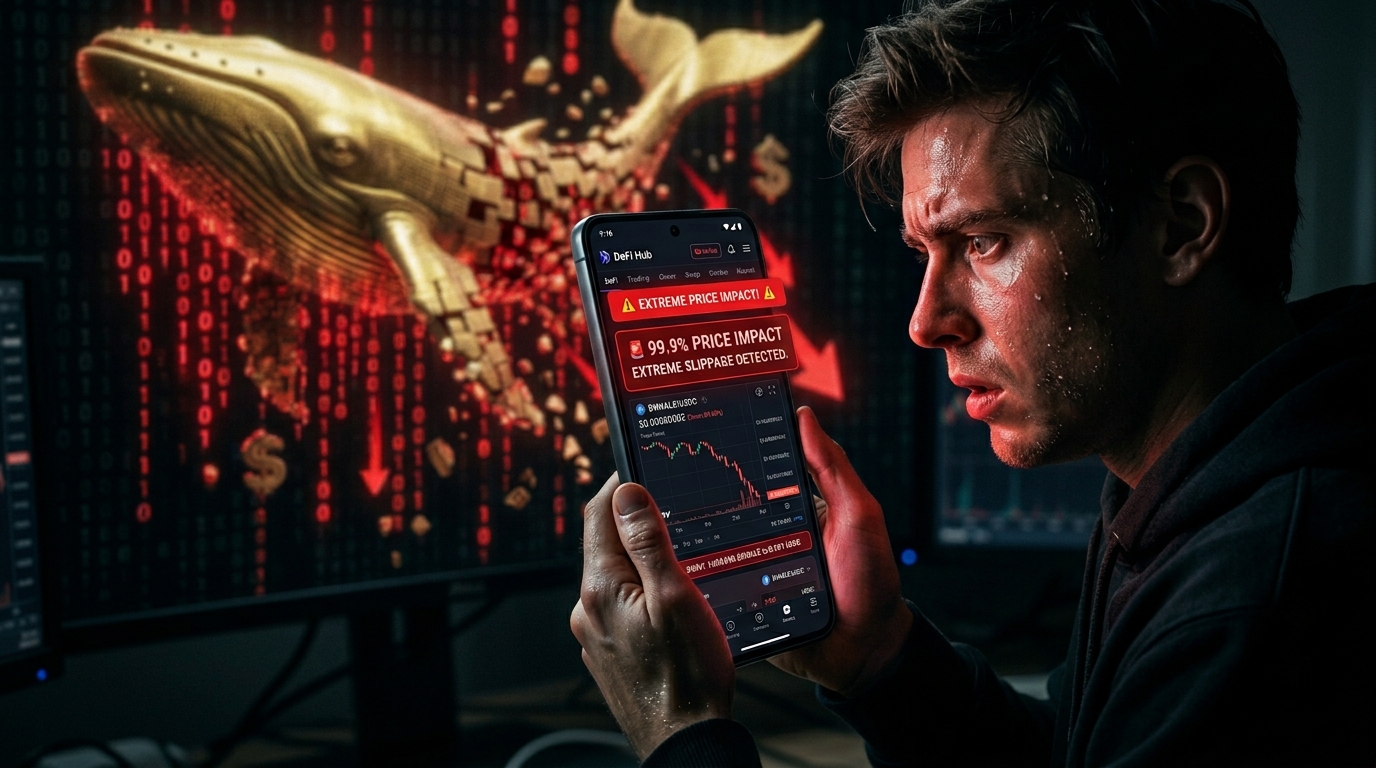
From $50 Million to $36,000: The Brutal Reality of DeFi Slippage
Intelligence Bureau
The decentralized finance (DeFi) ecosystem witnessed one of its most catastrophic execution errors on March 12, 2026. A high-net-worth trader, or "whale," attempted to swap approximately $50.4 million in Tether (USDT) for AAVE tokens. What should have been a routine institutional-sized trade resulted in the trader receiving a mere 324 AAVE tokens, worth approximately $36,000 at the time of execution.
The incident has sent shockwaves through the DeFi community, not because of a technical hack or a smart contract exploit, but because the protocol performed exactly as designed. The $50 million loss—representing a 99.9% value destruction—occurred after the user bypassed multiple "extraordinary slippage" warnings on a mobile interface.
This event highlights a critical friction point in the maturity of decentralized infrastructure: the balance between permissionless freedom and user protection. While traditional finance has "circuit breakers" and human oversight to catch "fat-finger" errors, the code-is-law reality of Ethereum saw this $50 million capital flight redistributed to MEV bots and block builders in milliseconds.
The fallout from this trade has prompted Aave founder Stani Kulechov to announce the development of "Aave Shield," a new security layer designed to hard-cap price impact at 25% to prevent future liquidations of this magnitude.
🌍 GLOBAL MARKET IMPACT
The impact of this $50 million blunder has been felt across multiple sectors of the crypto economy. Investor sentiment has momentarily soured regarding mobile-based DeFi trading, with heavy criticism directed at the UX of high-stakes transacting on handheld devices. However, ironically, the AAVE token itself saw a 5% price surge following the incident, as the massive "burn" of value and the ensuing viral news cycle brought intense attention to the protocol’s governance and resilience.
In the US, regulatory hawks are already using the incident as ammunition for the CLARITY Act, arguing that DeFi lack of "suitability requirements" makes it a danger to large-scale capital. Meanwhile, in Asia and Europe, on-chain analysts are focusing on the $50.4 million origin—a wallet that had recently withdrawn funds from Binance—suggesting a massive institutional or private wealth error.
🧠 ANALYST INSIGHT
"This wasn't a failure of code; it was a failure of the human-machine interface," says one senior market analyst at CoinDesk. "The trader was presented with a quote that effectively said, 'If you give us $50 million, we will give you $36,000.' They checked a box saying they understood, and the smart contract obeyed. It is the ultimate expression of 'permissionless'—the freedom to make a $50 million mistake."
⚠️ RISK FACTORS
Liquidity Fragmentation: The trade proved that even top-tier tokens like AAVE can suffer from localized liquidity "dead zones" if routing algorithms or users select the wrong pools.
UX Guardrails: The "checkbox" defense is proving insufficient for institutional-grade capital.
MEV Predation: Sophisticated bots are constantly monitoring the mempool for such errors, ensuring that value lost to slippage is almost never recoverable.
🔮 NEXT 24-HOUR OUTLOOK
In the immediate 24-hour window, expect AAVE to trade with high volatility as the "Aave Shield" governance proposal begins its initial voting phases. Support for the token remains strong at $104, while the viral nature of the news could push it toward a resistance test at $118. Traders should watch for any official communication from the "whale" wallet, though funds are widely considered unrecoverable.
📈 KEY TAKEAWAYS
The Loss: A trader turned $50.4M into $36K on Aave due to 99.9% price impact.
The Cause: Swapping $50M into a liquidity pool with only $73K in depth.
MEV Profit: Over $40M was captured by arbitrage bots and block builders.
Protocol Reaction: Aave is proposing "Aave Shield" to cap price impact at 25%.
Refund: Aave and CoW Protocol have pledged to refund $600K in collective fees.
Advertisement
728×90 Leaderboard