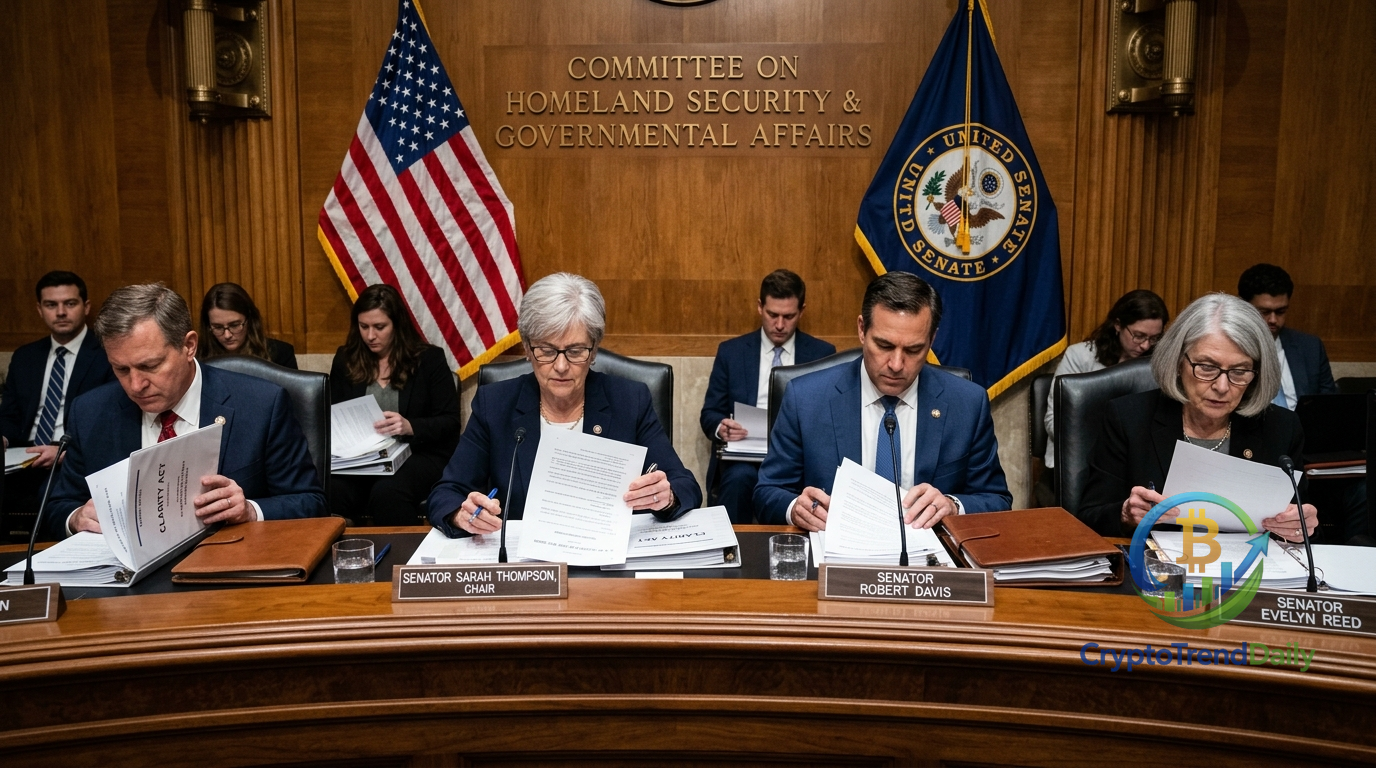
The CLARITY Act isn't just another piece of crypto legislation grinding through the Senate — it is the single most consequential regulatory inflection point for digital assets since Bitcoin's genesis block. On May 14, 2026, the Senate Banking Committee will convene at 10:30 AM ET to mark up the 309-page Digital Asset Market CLARITY Act, and prediction markets currently price the probability of enactment at approximately 67–71%, with the White House targeting a July 4 signing ceremony.
The bill's arrival at committee markup represents the culmination of a legislative journey that began with House passage at 294–134 in July 2025, stalled through months of banking-lobby friction over stablecoin yield provisions, and restarted when Senators Thom Tillis (R-NC) and Angela Alsobrooks (D-MD) delivered their compromise framework on May 1, 2026. Coinbase CEO Brian Armstrong — who had pulled the company's support in January, triggering the original postponement — returned to the table with a public endorsement, confirming Coinbase is working with at least five of the largest global banks to build compliant products under the new framework. The immediate market reaction has been unambiguous: Bitcoin surged past $82,000 on $1.63 billion in spot ETF inflows during the first week of May, and the stablecoin market surpassed $321 billion in total capitalization in April, a new all-time high.
But the surface-level price action obscures something far more significant. What makes the CLARITY Act structurally different from every regulatory effort that preceded it is that it does not merely clarify — it classifies. The bill draws a hard jurisdictional line between the SEC and CFTC, assigning oversight based on whether a token functions as a security with ongoing management-led profit expectations or as a digital commodity within a decentralized protocol. That division has been absent from U.S. law since Bitcoin's creation, and its absence has been the single largest barrier to institutional custody approvals at regulated fiduciaries. For the first time, corporate treasury departments at Fortune 500 companies will have a statutory basis — not just a no-action letter or enforcement discretion — for holding digital assets on their balance sheets.
For $USDC, the implications are even more direct. The bill's 1:1 liquid reserve mandate requires stablecoin issuers to back each token with short-duration U.S. Treasuries under 90 days, overnight repurchase agreements, and central bank deposits. Circle's $USDC, which had already shifted toward short-duration Treasuries and cash under BlackRock-managed custody at BNY Mellon, is positioned closer to compliance than any major competitor. Tether's USDT reserve disclosures have historically included corporate paper, money market funds, and secured loans — none of which would qualify under the CLARITY framework without restructuring. This is not a marginal advantage; it is the kind of regulatory moat that can reshape market share in an asset class projected to exceed $1 trillion in total supply within this cycle.
What Just Happened — And Why It Matters
On May 12, 2026, Senate Banking Committee Chairman Tim Scott released the full 309-page substitute text of the CLARITY Act just after midnight, 31 pages longer than the January draft. The bill is now scheduled for a markup vote on May 14 at 10:30 AM ET in Room 538 of the Dirksen Senate Office Building. The committee split stands at 13 Republicans to 11 Democrats, with all 13 Republican votes required for advancement. Senator John Kennedy (R-LA) remains the key uncommitted vote, and his hesitation, according to policy desk sources, has nothing to do with crypto policy — adding a layer of political unpredictability to an otherwise favorable count.
The bill's core provisions extend well beyond stablecoin regulation. It mandates that all digital commodity exchanges, brokers, and dealers be treated as financial institutions under the Bank Secrecy Act, compelling AML, KYC, and customer due-diligence requirements equivalent to banks. It creates a fundraising exemption allowing crypto companies to raise up to $50 million annually — and $200 million in total — without full SEC registration. It establishes criteria for defining sufficiently decentralized platforms, and it clarifies that tokenizing securities does not exempt them from existing securities laws. The bill also contains a provision barring the SEC from classifying any token that served as the principal asset of a U.S.-listed spot exchange-traded product as of January 1, 2026 as a security — language that would effectively grandfather Bitcoin and Ether into commodity classification.
The yield compromise at the center of the bill is deliberately constrained. Section 404 prohibits crypto platforms from paying passive, bank-style interest on stablecoins held by U.S. customers, but it explicitly permits rewards tied to "bona fide activities or bona fide transactions." The distinction is economically significant: a user parking $USDC in an exchange account earns nothing, but a user providing stablecoin liquidity to a decentralized exchange pool, settling a payment, or participating in governance can receive activity-based rewards. This framework effectively shifts the industry from a "buy and hold" yield model to a "buy and use" utility model — a restructuring that favors platforms with active transactional ecosystems over those that function primarily as interest-bearing depositories.
Historical precedent for this kind of legislative catalyst is instructive. When the GENIUS Act was signed into law in July 2025, establishing the first federal framework for payment stablecoin issuers, the stablecoin market cap grew approximately 50% over the subsequent twelve months, reaching $321 billion by April 2026. The GENIUS Act, however, was narrower in scope — it regulated issuers but left exchanges and third-party platforms largely unaddressed. The CLARITY Act closes that gap and extends regulatory architecture to market structure, DeFi governance, and token classification. If the GENIUS Act was the foundation, the CLARITY Act is the full building. The magnitude of capital currently sidelined by legal ambiguity — analysts estimate hundreds of billions in corporate treasury reserves, pension allocations, and sovereign wealth fund mandates — suggests the market response to passage could substantially exceed the post-GENIUS trajectory.
The first-order market reaction has been rational but incomplete. Bitcoin's move to $82,000 on $1.63 billion in weekly ETF inflows is significant, but the Fear and Greed Index sitting at approximately 38 — firmly in Fear territory — tells a more nuanced story. This is not retail FOMO driving prices higher. Institutional capital is making calculated bets on regulatory clarity, not euphoric speculation. The options market confirms this: skew remains biased toward downside protection, funding rates are soft, and the rally has been absorption-driven rather than demand-driven. The market is pricing in a probability-weighted outcome, not a certainty — and that leaves room for further repricing if the markup produces a clean advancement.
Market Impact: Price, Liquidity, and Institutional Behavior
Bitcoin is trading at approximately $80,960 on May 13, 2026, after a week that opened at $81,400, touched $82,000 twice, and rejected both times. The weekly candle is a textbook spinning top — opened near $81,400, high near $82,000, low near $79,300, closing near $80,960 — indicating equilibrium between buyers and sellers with neither side gaining decisive control. The 200-day exponential moving average sits at approximately $82,000, making that level the single most important technical threshold in the market right now. A daily close above $82,000 with volume confirmation would constitute the first bullish structural break since the Q1 correction. Conversely, failure at this level for a third time would likely invite a retest of the $78,100 zone, which Glassnode identifies as the "True Market Mean" and a critical support floor.
Volume analysis reveals a market backed by real conviction but not yet at escape velocity. The $1.63 billion in spot Bitcoin ETF inflows during the first week of May represents the strongest institutional buying impulse since the Q4 2025 rally. BlackRock's IBIT accounted for between 60% and 90% of daily flows and now holds approximately $75.8 billion in Bitcoin assets. Fidelity's FBTC accumulated alongside it through the rally. What distinguishes this inflow cycle from previous ones is the regulatory catalyst: institutions are not buying Bitcoin because of macro conditions — which remain challenging, with CPI at 3.8% year-on-year and the Fed holding rates at 3.50–3.75% with traders now pricing a chance of a rate hike — but because the CLARITY Act represents a structural de-risking of the asset class. That is a higher-quality buying rationale than momentum-chasing, and it suggests the inflows may be stickier.
On-chain data paints a picture of cautious positioning. $USDC ERC20 total supply stands at approximately 54.4 billion tokens on May 12, down from a local high of approximately 55.2 billion on May 10. The two-day decline represents roughly 800 million $USDC redeemed — institutions returning stablecoins to Circle in exchange for dollars. Exchange reserves sit at approximately 14.7 billion $USDC, near the lowest reading in the April–May visible range, representing roughly 27% of total supply. That means approximately 73% of ERC20 $USDC is held outside exchanges — in cold storage, DeFi protocols, or institutional custody — which is consistent with a market that is accumulating rather than distributing. When exchange reserves decline while prices rise, it typically signals that buyers are withdrawing assets to hold, not to sell.
Institutional behavior around the stablecoin ecosystem has accelerated dramatically in the weeks leading up to the markup. BlackRock filed for two tokenized money-market funds — BSTBL and BRSRV — with the SEC on May 8, explicitly targeting stablecoin holders seeking regulated yield alternatives. BSTBL is structured as a tokenized share class of BlackRock's existing Select Treasury Based Liquidity Fund, which holds $6.1 billion in assets, with tokens issued on Ethereum. BRSRV is a newly created fund with a $3 million minimum investment, designed to qualify as an eligible reserve asset under the GENIUS Act framework. JPMorgan followed with its own filing for JLTXX, a tokenized Treasury fund on Ethereum. These are not experimental pilots; they are production-grade infrastructure being built ahead of the regulatory framework that will govern them. The tokenized real-world asset market has surpassed $30 billion in total value and tripled over the past year, with tokenized Treasuries on Ethereum alone exceeding $8 billion.
Cross-market correlations reinforce the view that crypto is decoupling from traditional risk assets in a way that favors the regulatory-catalyst thesis. The DXY has weakened to approximately 98.38, down roughly 1.8% over the past month, despite hot inflation data that would normally support dollar strength. Gold has corrected 16% from its January all-time high of $5,589 to approximately $4,694, as geopolitical risk premiums fade. Equities remain near record levels but are showing signs of fatigue. In this environment, Bitcoin's rally is idiosyncratic — driven by a catalyst specific to crypto rather than a broad risk-on rotation. That idiosyncrasy is precisely what institutional allocators look for when evaluating an asset class for portfolio inclusion: returns that are not simply leveraged beta on equities.
Hidden Signals: What the Market Is Missing
The most important signal in the current market is not visible on price charts — it is in the velocity and distribution of stablecoin flows. JPMorgan analysts estimate that stablecoin transaction volume is running at an annualized pace of approximately $17.2 trillion in 2026, with $USDC processing nearly five times more on-chain transaction volume than USDT despite a market cap less than half its competitor's size. This divergence between supply and throughput is the hidden engine of the regulatory catalyst thesis: $USDC is not winning on market cap but on transactional utility, and the CLARITY Act's compliance framework is designed to accelerate exactly that dynamic. When the regulatory environment mandates reserve quality, audit transparency, and AML compliance at the level of traditional financial institutions, the stablecoin that already meets those standards gains an advantage that compounds over time.
A second underappreciated signal is the transformation of $USDC's holder base. On-chain data shows that $USDC active addresses on the Ethereum ERC20 network peaked at 197,265 on March 21, 2026, then fell sharply to 118,600 by April 23 — a 40% decline in 33 days — before recovering to approximately 145,110 by May 8. The partial recovery, still 26% below the March peak, has been misinterpreted by some analysts as bearish. In reality, it reflects a structural shift: retail DeFi activity cooled during the Q1 market drawdown, but institutional-sized transactions continued at elevated levels. The average transaction size has increased even as active address counts have declined, consistent with a user base that is becoming more institutional and less retail. This is the maturation pattern seen in every financial market that has transitioned from speculative to structural adoption.
The macro overlay presents a more complex picture than the regulatory headlines suggest. The Federal Reserve held rates at 3.50–3.75% at its April 29 meeting, and the April CPI print at 3.8% year-on-year — above expectations and the highest in three years — has shifted market pricing toward a potential rate hike rather than a cut. Higher rates are traditionally negative for risk assets, but they are unambiguously positive for stablecoin issuers: Circle generated $1.25 billion in revenue in H1 2026, with 95.5% coming from interest on the short-term Treasuries backing the $USDC supply. Every basis point of Fed policy rate flows directly to Circle's bottom line. This creates a fascinating asymmetry — higher rates pressure crypto asset prices but strengthen the stablecoin business model that underpins the ecosystem's liquidity infrastructure.
The geopolitical dimension adds another layer that most market commentary has missed. The DXY's weakness, despite hot inflation and a hawkish Fed, reflects capital flows responding to geopolitical uncertainty — specifically the Iran conflict and its impact on energy markets and supply chains. Galaxy Research has framed stablecoin adoption as predominantly offshore-driven, arguing that "foreign capital will flow into U.S. banking infrastructure at a rate that materially exceeds any domestic deposit migration." If that framing holds, the CLARITY Act's reserve mandate functions as an onboarding mechanism for foreign dollar demand into U.S. Treasuries — not a threat to domestic bank deposits. The non-obvious implication visible only on a 2–4 week horizon is that the banking lobby's opposition may weaken as data emerges showing stablecoin adoption is net-additive to Treasury demand rather than subtractive from bank deposits. The American Bankers Association escalated its lobbying over the weekend, but the empirical foundation of its argument is increasingly contested.
Narrative Shift: What Trend Is Actually Forming
The dominant narrative entering 2026 was regulatory overhang as a persistent headwind — the idea that U.S. crypto markets would remain structurally constrained by legal ambiguity through the cycle. That narrative is dying in real time. The CLARITY Act, combined with the GENIUS Act before it, represents a transition from regulation-by-enforcement to regulation-by-statute that fundamentally changes the risk calculus for every institutional allocator. The dying narrative is being replaced by what can be called the "compliance premium" thesis: in a regulated market, assets and platforms that are already compliant capture disproportionate share as fence-sitting capital enters. $USDC's 73% supply growth versus USDT's 36% in 2025 was the early signal; the CLARITY Act markup is the confirmation event.
A parallel narrative that is accelerating is the convergence of traditional finance infrastructure with crypto-native rails. BlackRock's BSTBL and BRSRV filings, JPMorgan's JLTXX, Visa adding Polygon to its global stablecoin settlement program, Modern Treasury integrating $USDC on Polygon into its enterprise payments API, Stripe's $1.1 billion acquisition of Bridge, and Circle settling $68 million in internal treasury via $USDC — these are not isolated experiments. They are the early architecture of a financial system in which stablecoins serve as the settlement layer and tokenized funds serve as the yield layer, with traditional banks providing custody, compliance, and distribution. The CLARITY Act provides the legal floor that makes this architecture viable at scale. When Coinbase CEO Brian Armstrong says the company is working with at least five of the largest global banks, he is describing a system being built in anticipation of this legislative framework, not in hope of it.
The narrative that should concern investors is the one that has not yet been priced: the possibility that the CLARITY Act's DeFi provisions — particularly the criteria for determining whether a platform is "sufficiently decentralized" — create a compliance burden that fragments liquidity between regulated and unregulated venues. The bill would treat platforms that fail the decentralization test as financial institutions subject to Bank Secrecy Act requirements. Protocols that have the ability to block users, hold private permissions, or maintain hard-coded special privileges for certain participants would not qualify as decentralized. This could create a bifurcated market where compliant DeFi attracts institutional capital while non-compliant DeFi operates in a parallel, less-liquid ecosystem. The market has not yet priced this fragmentation risk, largely because the language is complex and the implementation timeline — 360 days after enactment — pushes the impact beyond most traders' investment horizons.
Market Data Snapshot
As of the time of writing:
Metric | Data (Approximate) |
|---|---|
Bitcoin Price | $80,960 |
24h Change | -0.76% |
7d Change | Flat (opened $81,400) |
Total Crypto Market Cap | $2.78 Trillion |
24h Volume (Aggregate) | $85 Billion |
Market Sentiment (Fear & Greed) | 38 — Fear |
Key BTC Support Level | $78,100 (True Market Mean) |
Key BTC Resistance Level | $82,000 – $82,500 |
$USDC Market Cap | $79 Billion |
USDT Market Cap | $189 Billion |
Total Stablecoin Market Cap | $321 Billion |
Fed Funds Rate | 3.50–3.75% |
DXY | 98.38 |
Gold Spot | $4,688/oz |
Spot BTC ETF Inflows (Week 1 May) | $1.63 Billion |
CLARITY Act Polymarket Odds | 67–71% |
The data tells a market caught between a powerful regulatory catalyst and persistent macro headwinds. The Fear and Greed Index at 38, despite Bitcoin trading near $81,000, is the most important signal in this table — it reveals that the rally is institutionally driven and has not yet attracted the retail participation that historically marks cycle tops. The $82,000 resistance level, coinciding with the 200-day EMA, is the line that separates a bear-market rally from a genuine trend reversal. The stablecoin data reinforces the structural growth thesis: a $321 billion market growing 50% year-over-year while the broader crypto market corrected more than 20% in Q1 demonstrates that stablecoin adoption is decoupled from crypto speculation and driven by real-world utility — payments, treasury management, and cross-border settlement.
Bull Case
The bull case rests on the CLARITY Act advancing through markup with a clean vote, followed by full Senate passage before the August recess and a White House signing ceremony by July 4. Under this scenario, the regulatory clarity unlocks an estimated $200–500 billion in sidelined institutional capital — corporate treasuries, pension allocations, sovereign wealth mandates, and private banking platforms — that have been waiting for statutory certainty before deploying into digital assets. $USDC benefits disproportionately: its compliance-first architecture positions it to capture the majority of institutional stablecoin demand, potentially driving its market cap from approximately $79 billion toward $150–200 billion over 12–18 months as regulated payment rails, treasury management systems, and tokenized fund infrastructure come online.
Bitcoin's technical setup supports a move to $90,000–$95,000 on a confirmed break above $82,000, with analysts pointing to the Ichimoku Kumo breakout on the daily chart — a signal that has produced positive returns one month later in 20 of 26 historical instances, with an average gain of approximately 6.21%. The $1.63 billion in weekly ETF inflows, if sustained, would represent the strongest institutional accumulation phase since the Q4 2025 rally that took Bitcoin to its all-time high. Combined with the Strategic Bitcoin Reserve announcement reportedly expected "within weeks" from White House digital assets adviser Patrick Witt, the regulatory momentum could create a self-reinforcing cycle: clarity attracts capital, capital drives price, price attracts attention, and attention accelerates political momentum for further pro-crypto policy.
Probability: ~60%
Bear Case
The bear case centers on execution risk — the possibility that the markup produces an unfavorable amendment, that Senator Kennedy's uncommitted vote flips against the bill, or that the banking lobby succeeds in inserting language that weakens the activity-based rewards exemption. If the CLARITY Act stalls at committee — a low-probability but high-impact scenario — the regulatory catalyst that has driven the May rally would evaporate, and Bitcoin would likely retest the $72,000–$75,000 support zone where it spent much of April. The macro backdrop compounds this risk: CPI at 3.8%, a Fed on hold with hawkish bias, DXY strengthening on safe-haven flows, and geopolitical uncertainty around Iran all create a fragile environment for risk assets.
A more subtle bear case involves the stablecoin yield provisions themselves. If Section 404 is interpreted broadly by the SEC, CFTC, and Treasury in their joint rulemaking — which the bill mandates within one year of enactment — activity-based rewards could be constrained to a degree that undermines the economic viability of DeFi protocols serving U.S. customers. This would not collapse the stablecoin market but would bifurcate it: compliant, institutionally-oriented stablecoins like $USDC would thrive, while DeFi-native stablecoin use cases would migrate offshore. The market has not priced the risk of a two-tier stablecoin ecosystem where onshore capital is walled off from the highest-yielding DeFi opportunities.
Probability: ~25%
Most Likely Scenario (Base Case)
The base case assumes the CLARITY Act advances through markup with the Tillis-Alsobrooks compromise intact, passes the full Senate with bipartisan support, and is signed into law in Q3 2026. Under this scenario, the market reprices digital assets higher — Bitcoin to $85,000–$90,000 by year-end — but the move is gradual rather than explosive, as the implementation timeline (360 days after enactment) means most provisions do not take immediate effect. Institutional capital begins positioning ahead of the effective date, with corporate treasury adoption of stablecoins accelerating through 2027 as compliance infrastructure matures.
$USDC emerges as the primary beneficiary, with its market cap growth trajectory steepening as regulated entities choose it over less-compliant alternatives for settlement, treasury management, and as collateral in tokenized fund structures. The stablecoin market overall continues its structural growth, potentially reaching $500–600 billion in total market cap by end-2027, but the growth is concentrated in compliant, transparently-backed issuers rather than distributed across the sector. The key risk to this base case is not legislative failure but regulatory implementation — the rulemaking process that follows enactment will determine whether the CLARITY Act fulfills its promise or becomes another chapter in the long history of well-intentioned financial regulation producing unintended consequences.
Probability: ~60–65%
What Smart Investors Should Watch
Senate Banking Committee markup outcome (May 14, 10:30 AM ET): A clean advancement without hostile amendments is the single most important near-term catalyst. Watch for Senator Kennedy's vote and any last-minute language changes to Section 404.
Bitcoin $82,000 level with daily close confirmation: A close above this 200-day EMA threshold with volume above $30 billion in aggregate daily trading would confirm a structural breakout. Failure for a third time likely triggers retest of $78,100.
Spot Bitcoin ETF flow sustainability: The $1.63 billion weekly inflow pace must continue. A reversal to net outflows before the markup vote would signal that institutional conviction was weaker than the price action suggested.
$USDC exchange reserves (currently 14.7B): A decline below 14.5B would indicate continued accumulation. A spike above 15.5B would signal distribution and potential selling pressure on risk assets.
Polymarket CLARITY Act odds trajectory: Movement from the current 67–71% range above 80% would likely trigger a second leg higher in crypto prices. A drop below 55% would signal that legislative risk is being repriced.
Circle and Coinbase earnings and commentary (next quarterly cycle): Both companies have direct exposure to the CLARITY Act outcome. Forward guidance on institutional onboarding and stablecoin product launches will provide leading indicators of adoption velocity.
DXY and Treasury yield movements: A sustained DXY decline below 97.50 combined with stable or declining 2-year yields would create a macro tailwind. Conversely, DXY above 99.50 would pressure all risk assets including crypto.
Related Intelligence
The GENIUS Act implementation continues to shape the stablecoin landscape, with FinCEN and OFAC proposing AML and sanctions-compliance rules for payment stablecoin issuers in April 2026. BlackRock's BSTBL and BRSRV tokenized money-market fund filings represent the most significant convergence of traditional asset management with on-chain infrastructure since the spot Bitcoin ETF approvals. The Strategic Bitcoin Reserve announcement, reportedly expected within weeks according to White House digital assets adviser Patrick Witt, would add a sovereign-demand catalyst to an already potent regulatory narrative.