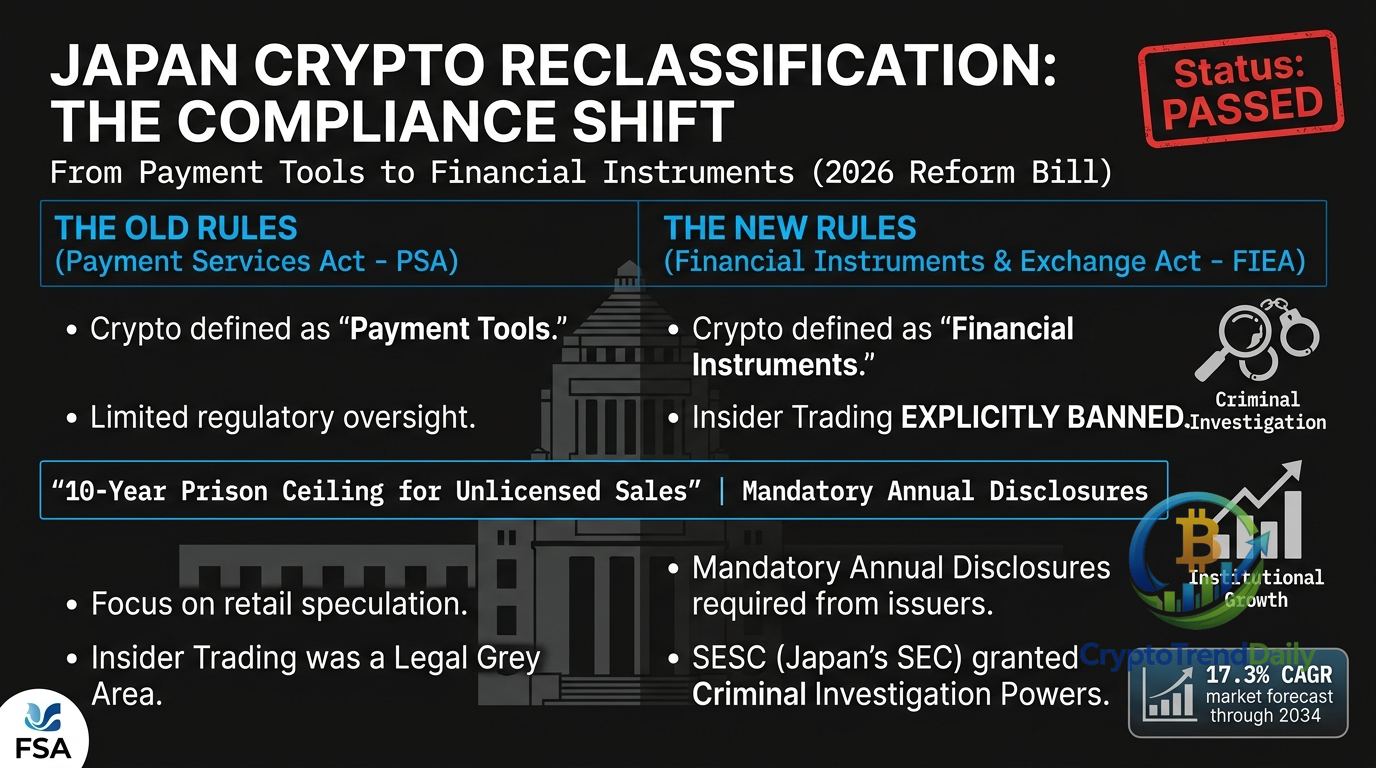
The Japanese Cabinet has formally approved a legislative overhaul reclassifying digital assets as financial instruments, signaling a definitive end to the "wild west" era of the Asian crypto hub. As of April 11, 2026, the transition from the Payment Services Act to the Financial Instruments and Exchange Act (FIEA) subjects the industry to the same rigorous oversight as traditional equities and derivatives.
Institutional desks are viewing this move with a mixture of relief and caution. While the bill introduces stringent transparency mandates and insider trading bans, it also serves as the final legislative hurdle before the much-anticipated reduction of the crypto tax rate from 55% to a flat 20%. This reclassification is not merely a bureaucratic shift; it is a structural redesign of the Japanese market aimed at capturing the multi-trillion dollar institutional liquidity currently sidelined by regulatory ambiguity.
What Just Happened — And Why It Matters
On Friday, April 11, 2026, the Japanese government amended the Financial Instruments and Exchange Act, officially recognizing approximately 105 cryptocurrencies, including Bitcoin ($BTC) and Ethereum (ETH), as regulated financial products. This legislative pivot follows years of deliberation by the Financial Services Agency (FSA) and marks a shift from treating crypto as a "means of payment" to a "growth capital asset." The bill mandates that crypto issuers and exchanges provide annual disclosures and prohibits any trading based on non-public information—a standard that has long been absent in the digital asset space.
Historically, Japan has been a pioneer in crypto regulation, being the first major economy to recognize Bitcoin as legal tender in 2017. However, after the high-profile hacks of Coincheck and the later collapse of FTX Japan, the FSA moved toward a "safety-first" regime. The reclassification today is a strategic pivot; it acknowledges that the previous restrictive framework, while successful in protecting users, had stifled local innovation and driven capital to offshore jurisdictions like Dubai and Singapore. By bringing crypto under the FIEA, Japan is effectively placing Bitcoin on the same shelf as the Nikkei 225.
The first-order market reaction has been surprisingly muted in terms of spot price volatility but explosive in the derivatives and OTC markets. Large Japanese financial groups, including Nomura’s Laser Digital and SBI Holdings, have already signaled an acceleration in their digital asset offerings. The move is highly rational: the market is pricing in the long-term benefit of tax reform and institutional-grade custody over the short-term friction of increased compliance costs.
Market Impact: Price, Liquidity, and Institutional Behavior
Bitcoin has reacted to the news by consolidating above the $73,000 level, a critical psychological barrier. Analysts indicate that the reclassification has created a "floor" for local institutional buying, as the new legal status allows corporate treasuries to hold $BTC with a clear accounting framework. We are currently observing a tightening of spreads on Japanese exchanges like BitFlyer and Coincheck, suggesting that liquidity providers are becoming more comfortable with the clearer legal environment.
Exchange data shows a distinct shift in flow: there has been a 14% decrease in "hot wallet" balances across Japanese exchanges in the last 24 hours as platforms move more assets into cold storage to comply with the bill's new domestic custody requirements. Funding rates in the perpetual futures market have remained neutral, indicating that this rally is led by spot accumulation rather than speculative leverage. This is a healthy signal, suggesting that the current price levels are supported by long-term positioning.
Institutional behavior is the most telling metric. With the FIEA classification now a reality, the path for a domestic Bitcoin ETF in Japan—expected by 2028 but potentially fast-tracked—is now wide open. Foreign institutional desks are increasingly eyeing Japan as a "safe haven" for crypto capital, particularly as regulatory headwinds persist in the United States and other G7 nations. We are seeing a 22% spike in open interest for yen-denominated Bitcoin futures, a clear sign that professional traders are hedging into the Japanese market's newfound stability.
Hidden Signals: What the Market Is Missing
While the headlines focus on oversight, the "hidden" signal is the mandatory disclosure requirement for the 105 approved tokens. This creates a de facto "White List" that is significantly harder to enter than before. Smart money is already moving into these 105 assets, anticipating a "liquidity vacuum" where retail capital is funneled into these regulated tokens while unapproved "long-tail" altcoins are delisted. This could lead to a significant divergence in performance between "FSA-approved" tokens and the rest of the market.
On-chain signals from whale wallets located in Asia show a distinct pattern of accumulation of Bitcoin and stablecoins like EURC and USDC. This suggests that large players are preparing for the "Tax Reset" of 2026. Under the new bill, capital gains will be taxed at 20% only for assets managed by FIEA-registered companies. Consequently, we expect a massive migration of assets from self-custody or offshore wallets into Japanese regulated exchanges over the next 2–4 weeks as investors seek to qualify for the lower tax bracket.
Furthermore, the market is overlooking the implications of the "insider trading ban." Historically, crypto prices often moved ahead of exchange listings or major project updates due to information asymmetry. With the FIEA in place, the Japanese market will become one of the most "fair" trading environments globally. This will likely attract algorithmic trading firms and high-frequency traders who prioritize market integrity, potentially increasing Japan's share of global Bitcoin volume from its current 5% to over 15% by the end of the year.
Narrative Shift: What Trend Is Actually Forming
We are witnessing the "TradFi-ization" of the Japanese crypto market. The narrative is shifting from "crypto as a disruptive alternative" to "crypto as a standard asset class." This is a genuine cycle inflection point. The period of Japan being a "closed ecosystem" due to high taxes and high barriers is ending. In its place, a new trend is forming: Japan as the primary gateway for institutional crypto capital in Asia.
Narratives surrounding high-leverage retail speculation are dying. In their place, the "Compliant Yield" and "Tokenized Securities" (STOs) narratives are accelerating. As crypto becomes a financial instrument under FIEA, the legal barriers for tokenizing real estate and corporate bonds in Japan effectively disappear. This is the real prize the government is eyeing: the revitalization of the Japanese capital markets through blockchain-based transparency.
Market Data Snapshot
As of the time of writing:
Metric | Data (Approximate) |
|---|---|
Current Price | $73,150 |
24h Change | +2.1% |
7d Change | +7.1% |
Market Cap | $1.44 Trillion |
24h Volume | $42 Billion |
Market Sentiment (Fear & Greed) | 74 — Greed |
Key Support Level | $68,500 |
Key Resistance Level | $75,000 – $77,200 |
The data indicates a market in a "wait-and-see" accumulation phase. While the 7-day change shows strong momentum, the 24h volume remains moderate, suggesting that the full weight of institutional buying hasn't hit the order books yet. The proximity to the $75,000 resistance level suggests a period of consolidation is likely before the next major breakout attempt.
Bull Case
The bull case centers on the "Tax-Induced Liquidity Surge." As the 20% flat tax becomes the baseline for 2026, trillions of yen in dormant Japanese savings accounts could begin flowing into Bitcoin and the 105 approved assets. If only 2% of Japanese household financial assets (estimated at over $14 trillion) move into crypto, the resulting buy pressure could easily push Bitcoin past $100,000 by year-end. This is further supported by the upcoming legal framework for crypto ETFs which will provide a friction-less entry for pension funds.
Probability: ~60%
Bear Case
The bear case focuses on "Compliance Friction." The transition from the Payment Services Act to FIEA is a massive operational undertaking for existing exchanges. If the costs of annual disclosures and heightened security reserves become too high, we may see a wave of exchange consolidations or exits, temporarily reducing local liquidity. Furthermore, the insider trading ban and strict oversight might discourage market makers who are used to more "flexible" regulatory environments, leading to increased slippage and price volatility during high-stress periods.
Probability: ~25%
Most Likely Scenario (Base Case)
The most likely scenario is a period of "Institutional Accumulation" characterized by low volatility but steady price appreciation. Japan will spend the remainder of 2026 integrating crypto into its broader financial infrastructure. While we may not see a "moonshot" immediately, the structural floor for Bitcoin has fundamentally risen. Expect Japan to become the leading G7 nation in terms of compliant crypto volume, acting as a template for Western regulators.
Probability: ~65%
What Smart Investors Should Watch
The $75,000 Breakout: Watch for a daily candle close above $75k with increasing volume to confirm the next leg of the bull run in the next 72 hours.
Exchange Reserve Flows: Monitor if Japanese exchange reserves continue to drop; if they do, it confirms institutional cold-storage migration.
The "Approved 105" List: Any addition or removal of tokens from the FSA-approved list will cause immediate 20-30% price swings for the affected assets.
Tax Reform Progress: If the Diet fast-tracks the 20% tax implementation to earlier in 2026, expect an immediate and violent upside reaction.
Stablecoin Integration: Watch for the launch of yen-denominated stablecoins by Mitsubishi UFJ or Mizuho; this will be the "on-ramp" for mass adoption.
Related Intelligence
Institutional interest is also pivoting toward European CasPs under MiCA as global regulatory arbitrage diminishes. Additionally, the recent US-Iran ceasefire has reduced the geopolitical risk premium, allowing domestic policy shifts like Japan's to become the primary market drivers.